


Contents
Theory
Introduction
From the dawn of society, each person has played a role that gives structure and meaning to society: first hunters and gatherers, then artisans, navigators, scientists, artists, doctors, engineers, digital creators, and an ever-expanding range of specializations. Over time, our ways of contributing have evolved, but the human need to feel that our lives have direction, purpose, and utility remains intact. However, in an era where options are virtually limitless, the question of which path to choose has become more complex than ever.
The goal is simple yet essential: to help you identify which careers are consistent with who you truly are, not just with what you think you want today. We want you to make an informed, strategic decision aligned with your present and future well-being. It's not about telling you what to study, but about giving you the scientific information necessary to choose with maturity, confidence, and a long-term vision.
Below, we present the scientific methodologies and theories that underpin this process. Each one provides a different perspective to understand the person in their entirety, and by integrating them with our patented exam, we are able to offer an accurate, in-depth, and truly personalized result.
Science / History
Over the last century, psychology has dedicated itself to understanding what constitutes the essence of a person: why they think the way they do, what drives their decisions, how they process information, what comes naturally to them, and what requires disproportionate effort. Behind these questions lies a constant quest to understand the internal mechanisms that guide human behavior and that, silently but powerfully, influence both success and personal satisfaction.
Over time, different areas—from personality and motivation to interests, values, cognition, learning, observable behavior, and adaptation to the environment—developed independent theoretical frameworks that explain essential components of human functioning. Each contributed a different piece: some allowed us to describe stable behavioral tendencies; others revealed the internal forces that drive sustained effort; some explained how we learn or what environments favor our performance; and others showed how interests and preferences guide our most important choices.

Today, bringing these perspectives together is not only possible, but essential. The most accurate career guidance isn't based on a single test, but rather on integrating multiple scientific models that, together, offer a comprehensive understanding of the individual: who they are, what motivates them, how they learn, in what environments they thrive, and along which paths they are most likely to develop authentically and sustainably.
This is what we do. We bring together validated methodologies, backed by decades of research, to offer in-depth, comprehensive, and evidence-based career guidance, capable of revealing not only what a person can study, but also why certain paths will resonate more with their identity, their way of thinking, and their natural way of navigating the world. Below, we present the history, evolution, and scientific basis of each model that makes up this approach.
Personality traits - Big Five
In the mid-20th century, psychology faced the challenge of understanding why people responded differently to the same situations. It was in this context that the Big Five model emerged, one of the most solid pillars of modern psychology. During the 1960s and 70s, researchers such as Ernest Tupes, Raymond Christal, and later Lewis Goldberg, Paul Costa, and Robert McCrae, used extensive factor analysis to identify stable patterns in human personality.
They discovered that thousands of descriptions could be consistently grouped into five universal dimensions: Openness to Experience (O), Conscientiousness (C), Extraversion (E), Agreeableness (A), and Emotional Stability (N). These dimensions predict with remarkable accuracy how a person handles pressure, how they organize themselves, how much they need structure, how they collaborate with others, and their style of adapting to change. In career guidance, the Big Five provides a very solid scientific basis: it allows us to anticipate what types of environments promote well-being, what emotional demands are compatible with the person, and what career paths might align better with their natural way of acting.
Cognitive styles - MBTI
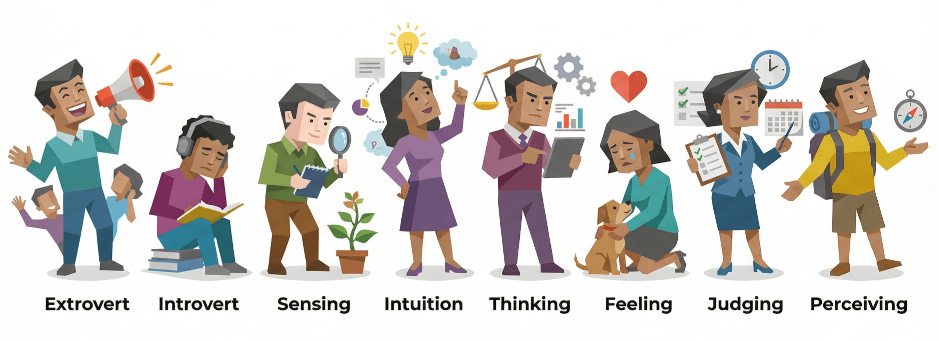
Almost simultaneously, but from a different perspective, Carl Gustav Jung laid the groundwork for a model that decades later would be known as MBTI (Myers-Briggs Type Indicator). In 1921, Jung proposed that human beings process reality through dominant psychological functions—Sensing (S), Intuition (N), Thinking (T), and Feeling (F)—expressed through the attitudes of Introversion (I) and Extraversion (E). Inspired by these ideas, Katharine Cook Briggs and Isabel Briggs Myers developed an operational model between the 1940s and 1960s to describe thought patterns and cognitive preferences. The MBTI classifies people into 16 types by combining four dichotomies: E-I, where E = Extraversion refers to an outward orientation of energy toward people and action, while I = Introversion indicates an inward focus on ideas and reflection; S-N, where S = Sensing represents a preference for concrete, factual information, while N = Intuition reflects a focus on patterns, possibilities, and abstract connections; T-F, where T = Thinking denotes decision-making based on logic and objective analysis, while F = Feeling emphasizes values, empathy, and the impact on others; and J-P, where J = Judging represents a preference for structure, order, and planning, while P = Perceiving reflects an inclination toward flexibility, spontaneity, and adaptation. Although it does not measure performance or pathology, its contribution is significant: it identifies cognitive styles and environments where a person processes information more fluently, directly influencing how they learn, how they collaborate, how they organize their work, and what types of tasks will favor their performance.
Vocational interests - RIASEC
A few years later, in the 1950s, psychologist John L. Holland presented one of the world's most influential vocational models: RIASEC. Holland discovered that occupational interests cluster into six relatively stable types: Realistic (R), Investigative (I), Artistic (A), Social (S), Enterprising (E), and Conventional (C). His theory posits that people thrive when there is a "congruence fit" between their interest patterns and the work environment. In career guidance, RIASEC is an essential compass: it allows for mapping careers compatible with a person's intrinsic motivation and predicting their persistence, performance, and long-term satisfaction.
Natural talents - CliftonStrengths (Gallup)
While Holland was studying interests, elsewhere in the world Don Clifton, considered the father of Positive Psychology, began in the 1990s to analyze what made certain professionals excel. Through factor analysis, longitudinal studies, and workplace surveys, Clifton and his team at Gallup developed the CliftonStrengths model, published in 1999. This model identifies 34 natural talents, which are stable patterns of thought, emotion, and behavior that can become strengths if properly developed. Its contribution is profound: it reveals which types of roles maximize a person's energy and performance, and which ones might drain motivation even if the person is capable of performing them.

Behavioral style - DISC
In addition, the research of psychologist William Moulton Marston, published in 1928, gave rise to the DISC model, widely used in organizational contexts. Marston proposed that people respond to their environment along two axes: perception of the environment (favorable or adverse) and tendency to act (active or passive). From this logic, four behavioral styles emerge: Dominance (D), Influence (I), Steadiness (S), and Compliance (C). In career guidance, DISC clarifies how a person communicates, how they make decisions, how they handle conflict, and what work pace is compatible with their natural style.
Learning style - KOLB
In 1984, Professor David Kolb presented the Experiential Learning Model, which directly connects learning with professional performance. Kolb proposed that learning involves an integrative cycle of concrete experience, reflection, abstract conceptualization, and active experimentation. From this cycle, four learning styles emerge: Divergent, Assimilator, Convergent, and Accommodator. These styles allow us to predict which work formats—analytical, creative, practical, or strategic—favor each person's natural development.

Learning styles - VARK
Subsequently, in the early 1990s, Neil Fleming introduced the VARK model, which focuses on preferred sensory modalities for information processing. This framework identifies four primary modes: Visual (V), Aural (A), Read/Write (R), and Kinesthetic (K). These modalities help determine how information is most effectively presented to each individual, supporting their natural development by enhancing comprehension, retention, and the speed at which skills are acquired in both academic and professional contexts.
Values - Schwartz
In the 1990s, social psychologist Shalom Schwartz conducted cross-cultural studies that culminated in the Universal Values Model. He identified 10 motivational values that guide fundamental decisions and behaviors. These values predict compatibility between an individual and different organizational cultures, explaining why someone may have the skills for a job but experience dissonance or internal conflict while performing it.

Multiple intelligences - Gardner
In 1983, psychologist Howard Gardner reformulated the understanding of intelligence by proposing the theory of Multiple Intelligences. Gardner demonstrated that human talent is diverse and that excellence can be expressed in logical-mathematical, linguistic, spatial, musical, kinesthetic, interpersonal, intrapersonal, and naturalist areas. In career guidance, this theory helps to identify natural cognitive abilities that can be aligned with coherent professional paths.
Career anchors - Schein
In parallel, MIT professor Edgar Schein developed the Career Anchors model in the 1970s and 80s, which was later validated across multiple industries. Schein discovered that each person develops a dominant career “anchor”—such as security, autonomy, impact, creativity, or technical specialization—that guides their career decisions, even when faced with attractive opportunities. This model helps identify which elements are non-negotiable for long-term satisfaction.

Motivations - McClelland
The work of David McClelland, along with Deci and Ryan's Self-Determination Theory, shaped the modern understanding of intrinsic and extrinsic motivations. These motivations directly influence persistence, effort, and goal selection. In career guidance, they allow us to anticipate which activities generate energy and which might lead to burnout.
Perseverance - Grit
In 2007, psychologist Angela Duckworth solidified the concept of Grit, defined as the combination of perseverance and sustained passion. Duckworth demonstrated that grit predicts success in demanding environments better than traditional indicators such as IQ. This model allows for the evaluation of perseverance in long-term careers.

Work context - Person-Environment Fit
Finally, the Person-Environment Fit model, developed over decades by authors such as Dawis and Lofquist, demonstrates that satisfaction, performance, and retention increase when personal style aligns with the style of the work environment. This approach integrates all the dimensions mentioned above and allows us to understand not only who the person is, but also where they can best realize their potential.